A house fire can affect a Simi Valley property in several ways at once. Flames and heat may damage materials near the source, smoke and soot can travel into rooms that never burned, and water used by firefighters or sprinklers may soak flooring, drywall, cabinets, insulation, and belongings. Outside the home, Ventura County's wildfire environment adds another concern because wind-driven smoke, ash, and soot can reach properties that never experience direct flames.
For homeowners, the first few days can bring questions about safety, cleanup, insurance, costs, belongings, and the condition of the structure. Commercial property owners and managers face similar concerns while also thinking about occupants, inventory, equipment, and business interruption. Insurance agents, adjusters, and carriers need accurate information about what was affected and how restoration is progressing.
Rytech Restoration of Ventura County helps bring those pieces together. The Simi Valley-based operation provides 24/7 emergency mitigation, water damage restoration, fire and smoke damage restoration, contents cleaning and packouts, mold remediation, and services for residential and commercial properties. Rytech's broader restoration model emphasizes fast response, IICRC-trained professionals, consistent documentation, insurance coordination, and more than 30 years of restoration experience.
Understanding what happens after a fire gives property owners a much better starting point for the decisions ahead.
What Are Common Causes of Fire Damage in Simi Valley Homes?
House fires can begin with cooking equipment, electrical components, heating equipment, appliances, candles, grills, smoking materials, and other ignition sources. Kitchens and garages deserve particular attention because heat sources, electrical equipment, fuels, and combustible materials often occupy relatively small areas.
Building layout changes what happens after ignition. Simi Valley includes tract homes dating back several decades, newer developments, hillside properties, multifamily buildings, and commercial facilities. Local Rytech content specifically notes homes ranging from 1970s-era tract construction to modern hillside properties, with materials such as drywall, engineered flooring, and slab foundations commonly encountered during restoration work.
Wildfire exposure adds a distinctly Ventura County concern. The county's Community Wildfire Protection Plan describes Simi Valley vegetation as including chaparral, grassland, woodland, and Pacific coastal scrub. The same plan identifies residential development as 71% of the city's total land area, creating substantial interaction between developed neighborhoods and the surrounding landscape.
That means two Simi Valley properties can have very different fire losses. One homeowner may be dealing with a contained kitchen fire and firefighting water, while another property may need evaluation for wildfire smoke, soot, ash, and odor.
“After years restoring properties across Ventura and Los Angeles counties, our team has learned that the visible fire area only tells part of the story. Simi Valley has everything from older tract homes to newer hillside properties, with drywall, wood framing, engineered flooring, slab foundations, and other materials that respond differently to heat, smoke, soot, and water. We also live with wildfire and wind-driven smoke exposure in this part of Southern California. Our job is to follow the damage through the property, understand what happened to those materials, and determine what can be successfully restored before unnecessary materials are removed.”
Mat Stone, Owner, Rytech Restoration of Ventura County
Mat Stone has previously described his team's experience restoring properties across Ventura and Los Angeles counties and dealing with both wildfires and internal structure fires in communities such as Simi Valley, Camarillo, and Moorpark.
What Should I Do Immediately After a Fire?
Personal safety comes first. Leave the building, account for occupants, and follow directions from firefighters and other emergency personnel. For an active emergency in Simi Valley, Ventura County Fire Department directs residents to call 911.
Once emergency officials release the property, contact your homeowners insurance provider and a professional restoration company. Photographs, video, inventories, and records of affected belongings can help establish the property's condition before restoration progresses.
Avoid immediately wiping soot from walls, ceilings, furniture, or other surfaces. Fire residues vary according to what burned, while drywall, wood, masonry, metal, flooring, and upholstery respond differently to cleaning. Moving soot-covered belongings through unaffected rooms can also spread residues.
Professional assessment gives the recovery process direction. The restoration team can investigate fire and smoke damage, identify water introduced during firefighting, evaluate contents, and determine which affected materials have restoration potential.
Rytech Restoration of Ventura County operates 24 hours a day from its Simi Valley location at 25 W Easy Street. That local availability allows homeowners, businesses, property managers, and insurance professionals to begin the restoration conversation quickly after a loss.
How Is Fire Damage Assessed and Inspected?
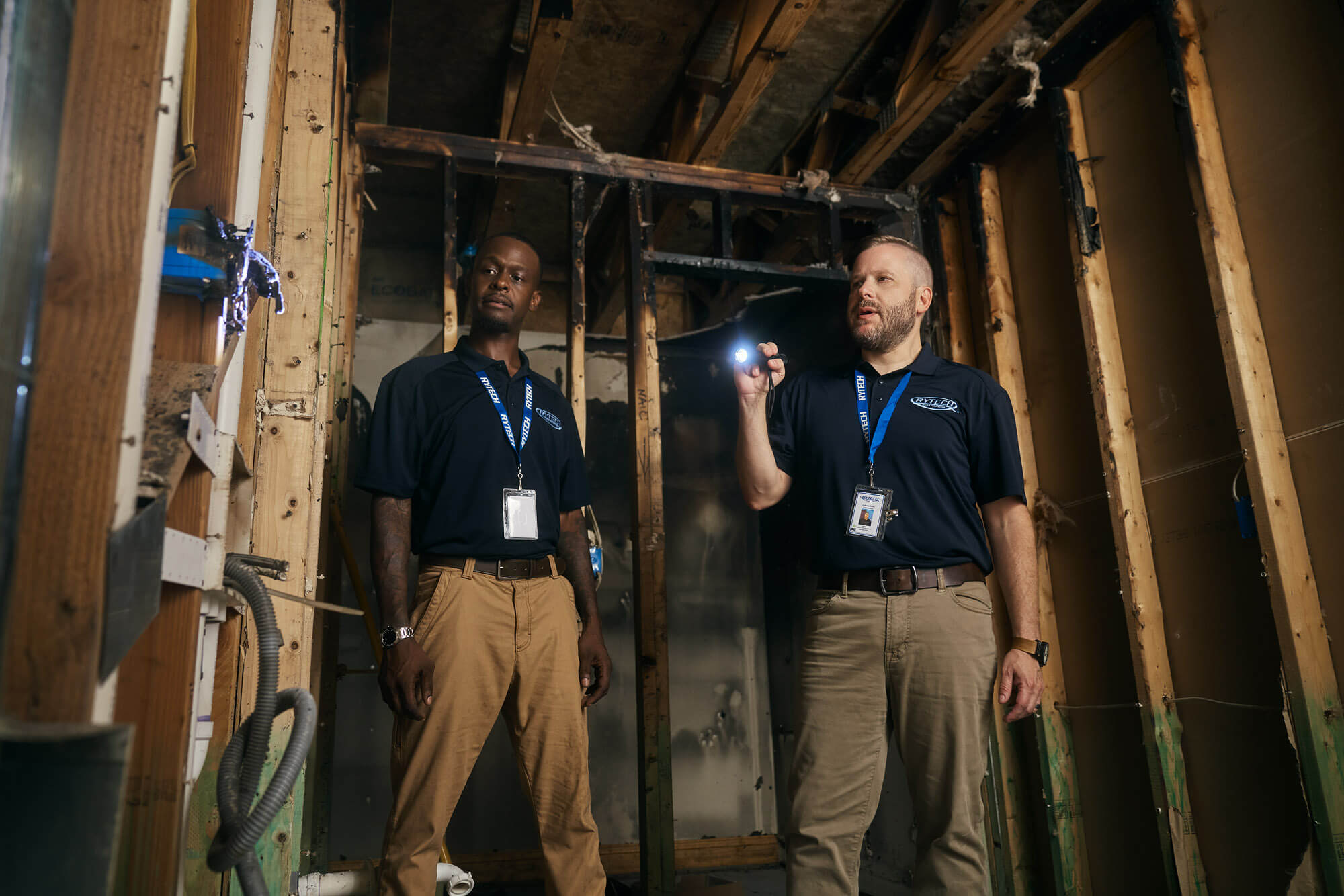
A professional inspection does not stop at the blackened surface nearest the fire. Technicians consider fire and heat damage along with smoke distribution, soot, odors, contents, structural materials, possible HVAC involvement, and water introduced during firefighting.
Imagine a kitchen fire in a Simi Valley home with engineered flooring over a slab. The flames may remain near the cooking area while smoke moves through adjoining rooms. Meanwhile, water can migrate underneath cabinets, flooring, or wall assemblies.
ANSI/IICRC S500 directs restorers to identify the full extent of water intrusion, including affected assemblies, building materials, and the edge of water migration. Inspection should continue outward from the source until the extent of migration has been identified and documented.
Professional tools can include moisture sensors, thermo-hygrometers, invasive and non-invasive moisture meters, infrared thermometers, and thermal imaging cameras. S500 also states that adjoining rooms should be inspected because water can travel beneath walls or come from above even when no water appears on the surface of the floor covering.
The resulting documentation creates a common reference point for property owners, restoration technicians, agents, adjusters, and carriers. It connects restoration decisions to observed and measured property conditions rather than assumptions.
How Do I Start an Insurance Claim After a Fire?

Contact your insurance company or agent and report the loss. Share basic information about what happened, when the fire occurred, and which areas appear affected. Your insurance professional can explain the deductible, limits, coverage provisions, and claim procedures associated with your specific policy.
Documentation helps establish what happened at the property. Photographs, videos, inventories, receipts, and information about damaged belongings can become useful parts of the claim record. Professional restoration documentation adds inspection findings, moisture readings when applicable, photographs, affected-area information, and records of work performed.
Most homeowners do not work with property claims regularly, so many steps and terms will naturally be unfamiliar. Agents, adjusters, carriers, and restoration professionals each have different responsibilities, and communication between those parties helps the process move forward.
Rytech's service model includes working directly with insurance companies and direct billing when applicable. The company's current brand guidance also emphasizes daily monitoring and regular updates so customers understand where their restoration project stands.
Commercial property managers can benefit from the same organization. When several stakeholders are involved, detailed project records help keep property owners, occupants, insurance professionals, and restoration teams working from the same information.
What Is the Difference Between Professional Fire Restoration and DIY Cleanup?
A soot mark on a painted wall may look like something a sponge can handle. The residue and the material underneath it make the situation more complicated.
Cooking oils, wood, plastics, fabrics, electronics, and other burned materials can produce different types of residues. Those residues may behave differently when they reach painted drywall, masonry, wood, metal, tile, carpet, or upholstery.
Professional restoration evaluates those conditions before choosing a cleaning procedure. Wildfire restoration guidance in the IICRC S760 material supports a stepwise approach that progresses from less aggressive to more aggressive restoration methods. The guidance also emphasizes evaluating material composition, condition, and location while avoiding methods that unnecessarily damage surfaces.
The difference becomes even clearer when the damage extends beyond visible soot. A professional team can investigate smoke pathways, contents, odors, HVAC involvement, structural materials, and firefighting water as connected parts of the same loss.
Rytech takes a restoration-first approach. Technicians evaluate whether affected materials can be successfully cleaned, dried, and restored before unnecessary demolition occurs. Materials that are beyond restoration can then be documented and removed as part of the mitigation scope.
What Does Fire Damage Restoration Typically Cost?
Fire restoration costs vary widely because a small smoke loss and a multi-room structure fire require very different amounts of work.
Current 2026 national consumer data from Angi places professional fire damage restoration at an average of approximately $27,477, with most projects ranging from about $3,083 to $52,031. The same source lists water damage associated with fire restoration at roughly $1,000 to $6,000 and soot removal at approximately $2,000 to $6,000. These figures are national consumer estimates rather than a Rytech estimate for a Simi Valley property.
Angi's 2026 data also reports average fire restoration costs can be higher in California than in many other states because labor-intensive restoration costs vary by geographic location. A local inspection provides a much more useful basis for understanding an individual Ventura County loss.
Affected square footage, fire type, amount of soot, water migration, contents, odor conditions, accessibility, labor, and specialty evaluations can all influence the scope. The condition and restoration potential of affected materials matter as well.
That last point can have a meaningful effect on the project. If a material can be successfully restored instead of unnecessarily removed, the property owner may avoid additional demolition and the work associated with replacing materials that could have remained in place.
Insurance compensation depends on the policy and covered loss. Your insurance professional can explain how dwelling coverage, personal property coverage, deductibles, limits, and other policy provisions apply.
How Are Smoke and Soot Removed After a Fire?
Professional smoke restoration starts by determining where residues traveled. In a structure fire, that investigation may lead beyond the room where flames were visible.
Technicians then consider the affected material and the type of residue before choosing cleaning methods. Drywall, finished wood, masonry, metal, flooring, upholstery, and household contents may require different approaches.
Wildfire residue adds another layer in Simi Valley. IICRC S760 addresses wildfire-related soot, char, ash, and odor and supports a restoration process that can progress from light surface cleaning toward heavier cleaning when conditions require it. HEPA vacuuming is identified as a primary method for removing loose wildfire particles during light cleaning.
HVAC systems also deserve attention when conditions indicate smoke or wildfire residues may have entered the system. S760 notes that duct openings can become part of cross-contamination control during wildfire cleaning.
Rytech Restoration of Ventura County provides professional fire and smoke damage restoration in Simi Valley for residential and commercial properties. The local operation lists fire and smoke restoration, contents cleaning, and packout services among its core capabilities.
How Are Smoke Odors Removed?
A room can look clean while the smell of smoke remains. That lingering odor can point toward residues on surfaces, contents, porous materials, or less visible spaces.
Professional deodorization works together with source removal and cleaning. IICRC S760 wildfire guidance recommends focusing odor reduction on eliminating odor sources rather than temporarily masking wildfire-related odors.
The exact process depends on what burned, how much smoke was produced, and where it traveled. Detailed surface cleaning, contents treatment, air filtration, ventilation, and professional deodorization methods may become part of the restoration plan.
Wildfire odor can be particularly challenging because some smoke-related compounds can remain associated with particles and materials after the visible smoke has disappeared. S760 notes that gases associated with smoke odor can continue to emit from char after the smoke itself is gone.
If a Simi Valley home looks clean but still smells like the fire, that odor gives the restoration team another clue about where additional evaluation may be needed.
What Happens When Firefighting Water or Sprinklers Soak the Property?
The water that stops a fire can create a second property damage problem. Fire hoses and sprinkler systems can wet flooring, drywall, insulation, cabinets, framing, ceilings, and belongings.
Water does not always remain where you can see it. ANSI/IICRC S500 directs restorers to evaluate and document moisture migration and inspect adjoining rooms because water can move under walls or enter from above.
After identifying affected materials, the restoration team establishes dry standards and drying goals. S500 describes establishing the dry standard by evaluating comparable materials in unaffected areas and calls for drying goals expected to inhibit microbial growth and return affected materials to an acceptable moisture condition.
Measurements continue during drying. S500 calls for documented monitoring, normally daily until drying goals have been met, although monitoring frequency may be adjusted based on the agreed scope, secondary-damage potential, access, or agreement among materially interested parties.
That changes the homeowner's question from “Does the wall feel dry?” to “What do the moisture readings show?”
What Happens if Mold Develops After Fire Sprinkler Use?
Water from fire suppression can reach areas that are difficult to see. Moisture may remain underneath flooring, behind walls, inside cabinets, or within other building assemblies.
When mold is discovered or suspected, ANSI/IICRC S500 directs restorers to the S520 Standard for Professional Mold Remediation. S520 evaluates contaminated materials based on factors such as porosity, ability to support fungal growth, ability to trap mold spores, and structural integrity.
Containment helps separate affected work areas from unaffected portions of the building. S520 describes source, local, and full-scale containment and discusses HEPA-filtered air filtration devices used as part of engineering controls for appropriate projects.
Professional mold remediation focuses on controlling contamination, physically removing affected mold contamination, cleaning appropriate materials, and reducing harmful mold spores in the indoor environment. The method depends on the materials and conditions found during assessment.
Rytech Restoration of Ventura County provides mold remediation alongside water and fire restoration, which can be helpful when one fire loss creates several connected restoration needs.
How Is Structural Damage Handled After a Fire?
Fire and heat can affect framing, roofs, floors, walls, and other structural components. The condition depends on the material, its distance from the fire, the temperature reached, and how long it was exposed.
Simi Valley properties can contain wood framing, concrete slabs, masonry, stucco, drywall, engineered flooring, tile, and other building materials. Hillside homes and commercial facilities can add different structural layouts and access challenges.
IICRC S760 identifies wood, steel, concrete, and masonry as typical structural building materials and states that restorers should recognize evidence of heat and fire impact that may have compromised structural components and require additional expertise.
Rytech's role centers on mitigation and restoration. Technicians evaluate affected materials, restore materials that can be successfully saved, and remove materials that are beyond restoration. When structural integrity requires specialized analysis, an engineer or another appropriately qualified professional can become part of the recovery team.
This distinction matters. Being near a fire does not automatically mean a building material should be removed. Its actual condition and restoration potential should guide that decision.
Can Personal Belongings Be Saved After Fire Damage?
Smoke exposure does not automatically make every item in an affected room a total loss. Furniture, clothing, décor, household goods, and other belongings can be evaluated based on material, heat exposure, soot, odor, moisture, value, and response to cleaning.
Some contents may be cleaned at the property. Others may benefit from a professional packout so selected belongings can be documented and moved while structural restoration progresses.
Packouts can also create better access to affected walls, floors, cabinets, and other building materials. On a larger residential or commercial loss, separating contents work from structural restoration can make the project easier to organize.
Rytech Restoration of Ventura County specifically lists contents cleaning and packout services as part of its fire and smoke restoration capabilities. Detailed contents documentation can also help property owners and insurance professionals keep track of affected belongings throughout the process.
When an item cannot be successfully restored, that condition can be documented so the property owner and insurance professionals have information for the decisions that follow.
What Health and Safety Conditions Can Remain After a Fire?
Extinguishing the flames does not automatically return the property to its pre-fire condition. Smoke and soot residues may remain, heat can affect building components, electrical systems may require evaluation, and firefighting water can remain inside assemblies.
Wildfire events create another type of post-fire condition. Smoke, ash, soot, char, and odor can affect properties even without direct structural burning. Wind can also carry wildfire particles into exterior surfaces, openings, garages, attics, and other areas.
S760 recognizes that wildfire restoration can be dynamic because hidden conditions may be discovered and cleaning effectiveness can vary. The guidance calls for a restoration work plan following the initial inspection, with anticipated outcomes communicated to materially interested parties.
For homeowners, a more useful question than “Where did the fire burn?” is:
“Where did the heat, smoke, soot, ash, odor, and water travel?”
That broader question gives the restoration team a much clearer starting point.
How Long Does Fire Damage Restoration Usually Take?
A small smoke-cleaning project can move much faster than a large fire involving multiple rooms, contents, structural drying, odor treatment, and specialty evaluations.
Current 2026 consumer data from Angi reports an average overall fire restoration timeline of approximately four months, with projects ranging from about two weeks to 12 months depending on severity. That broad recovery timeline can include work beyond Rytech's mitigation and restoration scope.
Affected square footage, soot conditions, moisture, contents processing, accessibility, and material condition influence the restoration schedule. Previously hidden conditions can change the scope once technicians gain access to affected spaces.
Wildfire projects can also evolve as conditions become clearer. S760 specifically recognizes the potential for deviations from the original scope because of hidden conditions and varied restoration effectiveness.
Communication helps homeowners and insurance professionals understand those changes. Rytech's brand process emphasizes daily project monitoring and regular updates so customers know where restoration stands.
How Do I Choose a Fire Damage Restoration Company in Simi Valley?
Start with professional qualifications and restoration experience. Ask whether technicians have IICRC training, whether the company is appropriately licensed and insured, and whether it regularly handles fire, smoke, water, odor, and contents losses.
Then ask about inspection. How will technicians determine where smoke traveled? How will hidden firefighting water be located? What moisture-detection equipment will be used? How does the company decide whether a material can be restored before removing it?
Project communication deserves equal attention. Homeowners and property managers should know what technicians found, what work is underway, and how conditions are changing. Agents, adjusters, and carriers benefit from clear documentation for the same reason.
Rytech Restoration of Ventura County operates locally from Simi Valley and provides 24/7 emergency mitigation for residential and commercial properties. The local team serves Ventura, Los Angeles, Santa Barbara, and Riverside counties, while Rytech's national brand brings more than 30 years of restoration experience, IICRC-focused technical expertise, and an established insurance-partner model.
Local knowledge adds another layer. Mat Stone has described his team's experience with Simi Valley's older homes and newer developments, as well as the region's wildfires, drought conditions, storms, flooding, and other property damage events.
How Can Simi Valley Homeowners Reduce Future Fire Damage?
Prevention begins inside the home. Stay close to active cooking, keep combustible materials away from heat sources, maintain electrical and heating equipment, and pay attention to garages and other spaces where ignition sources may be near stored materials.
Smoke alarms and a practiced escape plan provide another layer of preparation. Families should know how they will leave the property and where everyone will meet outside.
Simi Valley homeowners also live in a community with meaningful wildfire exposure. The Ventura County Community Wildfire Protection Plan identifies chaparral, grassland, woodland, and coastal scrub among the vegetation around Simi Valley. Property owners can use Ventura County Fire Department preparedness resources to better understand local wildfire planning and home fire safety.
Local fire rules also reflect that risk. Ventura County Fire Department states that fireworks are not legal in Simi Valley and several other Ventura County cities, and the department encourages residents to attend authorized professional displays instead.
Finally, review your homeowners insurance coverage periodically and maintain a current home inventory. Photographs or video of rooms, major possessions, and valuable belongings can provide useful documentation if a future fire or wildfire affects your property.
Get Inspected to Stay Protected After Fire or Smoke Damage in Simi Valley
Once firefighters leave, recovery moves into a different phase: determining how far the damage actually traveled.
Rytech Restoration of Ventura County serves homeowners, commercial businesses, property managers, and insurance professionals throughout Simi Valley and Ventura County, including communities such as Camarillo, Moorpark, Thousand Oaks, Newbury Park, Oxnard, Ventura, Santa Paula, Fillmore, Ojai, Westlake Village, Santa Clarita, Valencia, Chatsworth, Porter Ranch, Malibu, and other communities across Ventura, Los Angeles, Santa Barbara, and Riverside counties.
If your home, rental property, commercial facility, or insured property has been affected by fire, smoke, soot, wildfire ash, odors, sprinkler discharge, firefighting water, or related moisture damage, call Rytech Restoration of Ventura County at (805) 980-9155. The Simi Valley team is available 24/7 to help you understand the damage and determine what needs attention next.
GET INSPECTED TO STAY PROTECTED.
FAQs: Answering Your Pressing Fire Damage Repair Questions
At Rytech Restoration of Ventura County, we know that fire damage can be overwhelming. To help you through this difficult time, we’ve created a list of FAQs to give you a better understanding of our services, the restoration process, and what to expect when you choose to work with us.


